
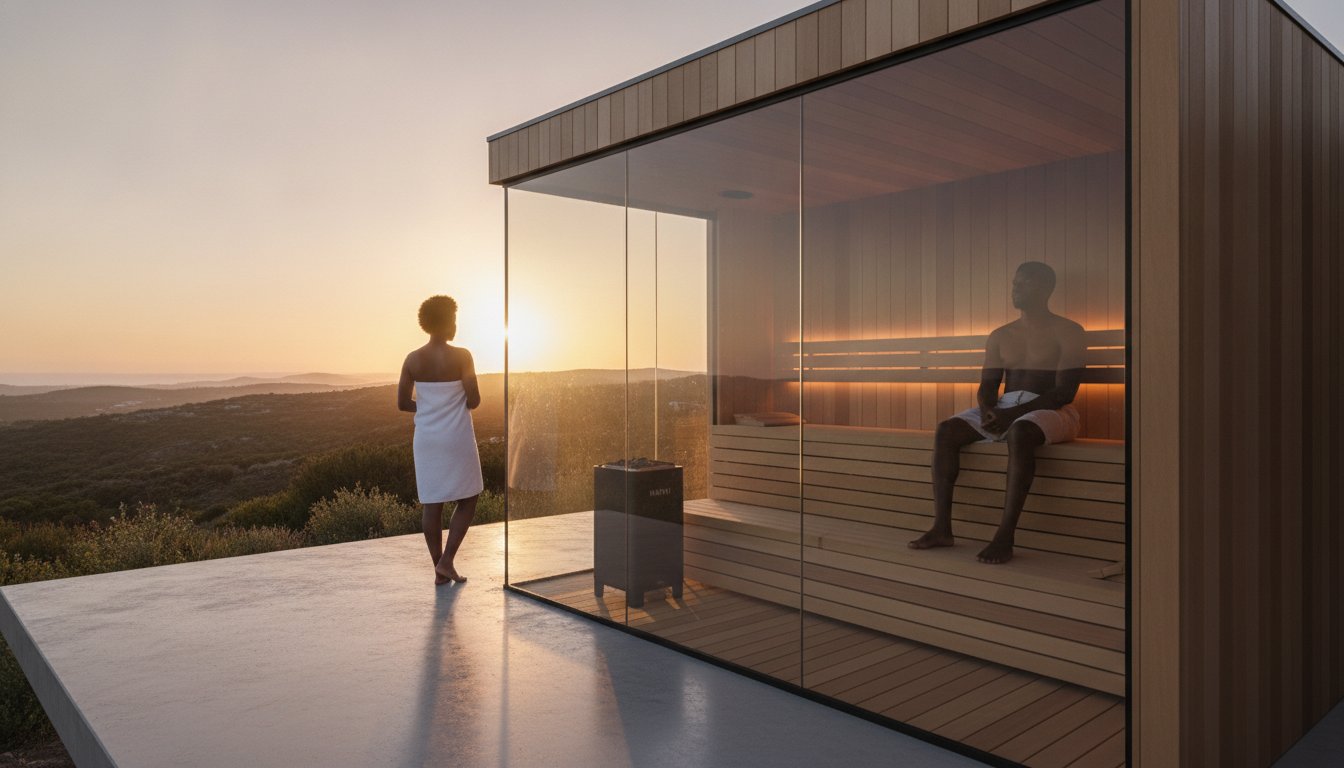
A home sauna is far more than a luxury appliance; it’s a permanent architectural investment in your long-term restoration and property value. You’ve likely spent hours weighing the merits of traditional heat against infrared technology, perhaps worrying about how imported timber will withstand the unique intensity of the South African climate. It’s natural to feel hesitant when faced with modular units that promise much but often lack the structural integrity required for a lifetime of use.
This guide simplifies the process of how to choose a home sauna by focusing on the essential intersection of heating precision, material durability, and bespoke design. You’ll learn how to distinguish between fleeting trends and enduring quality, ensuring your investment becomes a reliable sanctuary rather than a maintenance burden. We will examine the technical nuances of Narvi heating systems and the artisanal construction methods that transform a simple room into a high-performance wellness environment.
Key Takeaways
- Learn the technical nuances of heating technology and material integrity to master how to choose a home sauna that withstands the South African climate.
- Understand the fundamental differences between the dry, penetrating warmth of infrared and the high-humidity ‘löyly’ ritual of traditional steam saunas.
- Assess the structural and electrical requirements for both indoor and outdoor installations to ensure seamless integration into your home’s architecture.
- Discover why bespoke construction and high-performance Narvi heaters offer superior longevity and property value compared to mass-produced modular units.
- Optimise your private sanctuary’s layout by balancing seating capacity with ergonomic design for ultimate restorative comfort.
Defining Your Wellness Ritual: Traditional vs Infrared Heat
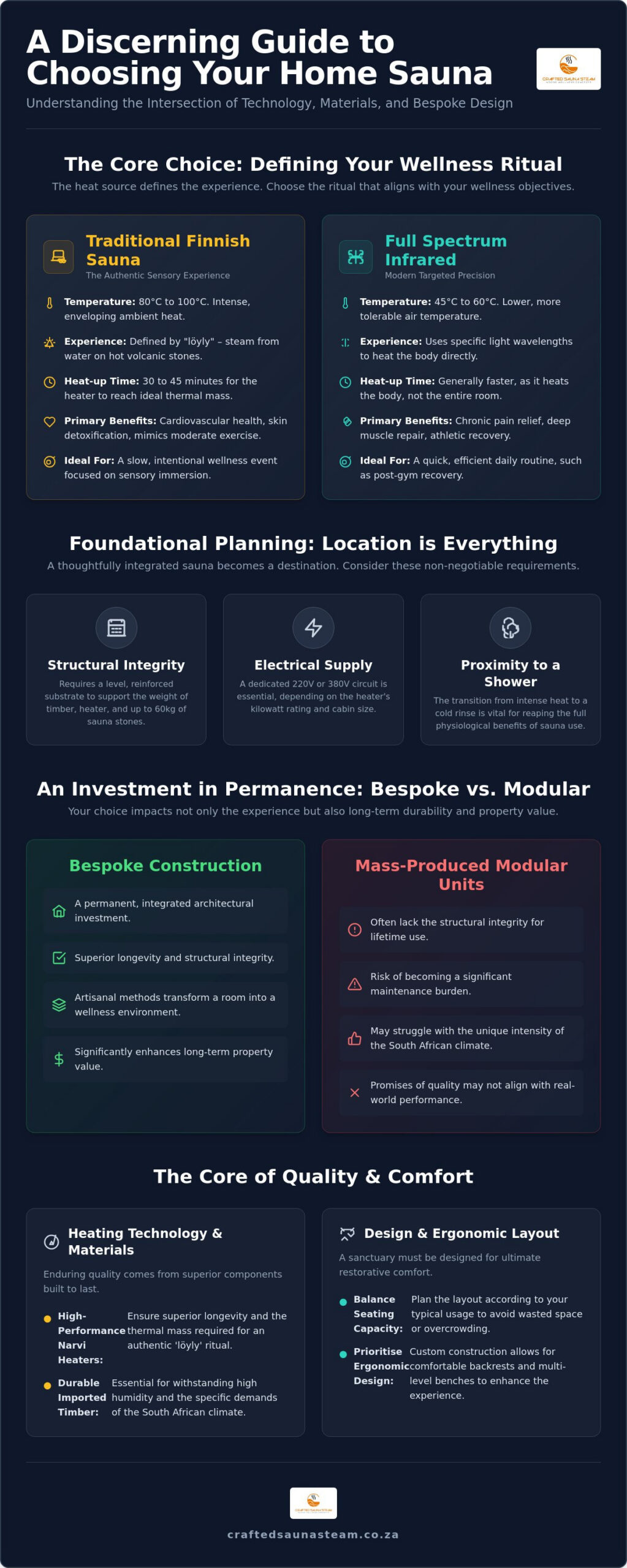
Deciding between traditional heat and infrared technology is the first significant step in mastering how to choose a home sauna that aligns with your personal restorative needs. It isn’t merely a technical choice. It’s a choice of ritual. Whilst both methods offer profound health benefits, they interact with the human body in fundamentally different ways. Traditional units heat the air to create an intense external environment, whereas infrared systems use light waves to warm the body directly. Exploring the history and types of saunas reveals how these distinct philosophies have evolved to serve different wellness objectives.
The Authentic Traditional Finnish Experience
For many, the gold standard remains the traditional Finnish sauna South Africa enthusiasts prize for its sensory depth. These cabins typically operate between 80°C and 100°C. The experience is defined by “löyly”, the restorative cloud of steam created by pouring water over heated volcanic stones. This ritual provides a significant cardiovascular challenge, mimicking the effects of moderate exercise. It requires a deliberate time commitment, as high-quality heaters need 30 to 45 minutes to reach the ideal thermal mass. It’s a slow, intentional process that rewards patience with a deep, purifying sweat.
The Modern Precision of Full Spectrum Infrared
If your focus lies in athletic recovery or deep tissue healing, full spectrum infrared offers a different kind of precision. Instead of relying on extreme ambient heat, these systems use specific wavelengths of light to penetrate several centimetres into the muscle tissue. This allows for a lower, more tolerable air temperature, usually between 45°C and 60°C. It’s an excellent option for those who find high humidity stifling or have limited time. Full spectrum technology is vastly superior to basic far-infrared panels, as it provides the complete range of near, mid, and far-infrared waves for comprehensive cellular benefits. Athletes seeking to reduce Delayed Onset Muscle Soreness will find that a dedicated sauna for muscle recovery accelerates cellular repair and optimises systemic restoration between training sessions. For a detailed electric vs infrared sauna comparison that examines atmospheric intensity against cellular penetration, our dedicated guide provides the technical clarity needed to make a confident decision.
Consider these factors when defining your personal wellness ritual:
- Therapeutic Intent: Choose traditional for cardiovascular health and skin detoxification; opt for infrared for chronic pain relief and muscle repair.
- The Sensory Environment: Traditional saunas offer the tactile hiss of steam and the aroma of heated timber; infrared provides a dry, focused, and quiet heat.
- Time Management: Traditional sessions are often a dedicated evening event; infrared fits seamlessly into a quick daily post-gym routine.
When you’re deciding how to choose a home sauna, remember that your preference for heat intensity will dictate the entire design and ventilation requirements of your private sanctuary. Whether you seek the ancestral heat of the stones or the modern efficiency of light, the choice should reflect the pace of the life you wish to cultivate.
Selecting the Perfect Location: Indoor vs Outdoor Installations
Placement is the foundation of your daily ritual. A poorly situated cabin becomes a neglected room. A thoughtfully integrated one becomes a destination. When considering how to choose a home sauna, you must look beyond mere floor space. You need to evaluate the structural integrity of your flooring, the proximity of high-amperage electrical supply, and the necessity of adequate ventilation. A standard traditional heater requires a dedicated 220V or 380V circuit, depending on the kilowatt rating and the size of the cabin. Additionally, the concentrated weight of the timber, the heater, and up to 60kg of sauna stones necessitates a level, reinforced substrate.
Proximity to a shower is a non-negotiable factor for an authentic experience. The transition from intense heat to a cold rinse is essential for the physiological wellness benefits and trends currently shaping modern home design. If your master suite lacks the capacity, a bespoke conversion of a nearby dressing room or basement space may offer the necessary privacy and plumbing access. Privacy is the silent partner of restoration. Whether you select a secluded corner of your garden or a repurposed guest suite, the location must feel secure from the interruptions of daily household traffic.
Seamless Indoor Integration
Indoor installations offer the pinnacle of convenience. They allow you to maintain your wellness routine regardless of winter downpours or summer storms. Master artisans prioritise meticulous moisture barriers and mechanical ventilation to protect your home’s structural timber from the high humidity levels of a traditional sauna. This approach ensures your sanctuary remains a permanent, value-adding asset to your property. Year-round accessibility means your investment is never at the mercy of the elements.
Creating an Outdoor Wellness Oasis
An outdoor installation offers a profound connection to the natural world. There’s a unique serenity in stepping from a 90°C cabin into the crisp night air of a South African garden. However, these structures demand superior material integrity. They require specialised cladding and roofing to withstand intense UV radiation and seasonal downpours. Planning for these units involves managing foundation levels and discreet electrical runs to ensure the aesthetic remains unblemished by utility lines. The garden setting provides a sensory cool-down phase that an indoor room cannot replicate.
Ultimately, your decision hinges on whether you prefer a private interior retreat or a garden-based sanctuary. Each path offers distinct architectural opportunities to enhance your lifestyle. If you’re unsure which environment suits your property best, consulting with experts in indoor and outdoor sauna installations can provide the technical clarity needed to move forward with confidence. Determining how to choose a home sauna location is about balancing these technical constraints with your vision for a peaceful, restorative space.
Evaluating Material Quality and Heating Technology
The longevity of your investment rests on two pillars: the integrity of the timber and the engineering of the heating element. When research turns to how to choose a home sauna, many homeowners overlook the technical specifications of these components, yet they dictate the quality of every session. In the South African climate, where humidity and temperature fluctuate significantly, choosing materials that resist warping is essential for structural stability. A high-performance cabin must withstand years of intense thermal expansion and contraction without compromising its airtight seal.
The Importance of Premium Timber Selection
Nordic woods like Spruce and Hemlock are the preferred choice for master artisans. Their slow-growth cycles in cold climates result in a high density that offers exceptionally low thermal conductivity. This ensures the benches remain comfortable to the touch even as the air temperature peaks. Western Red Cedar is another favourite for its natural resistance to decay and its signature aromatic profile. Professional construction involves more than just selecting the right species; it requires meticulous seasoning and jointing techniques to prevent the wood from degrading under the stress of extreme heat cycles. Inferior timbers will often crack or weep resin, ruining the aesthetic and the comfort of the space.
Narvi Heaters: The Gold Standard of Nordic Engineering
The heater is the heart of the sanctuary. Mass-produced units often rely on thin-gauge steel components that can fail after a few years of regular use. In contrast, Finnish-engineered Narvi heaters utilise robust cast iron and thick-walled steel to ensure decades of service. As the exclusive South African importer of Narvi technology, Crafted Sauna Steam prioritises systems with significant stone capacities. A larger volume of stones allows the heater to retain thermal mass more effectively, producing a “softer”, more enveloping steam when water is applied. This creates a superior “löyly” that feels restorative rather than harsh on the respiratory system.
Precision is paramount. Advanced digital control systems allow for exact temperature management, ensuring your environment is perfectly calibrated before you even step inside. This level of technical sophistication distinguishes a high-performance build from a basic modular kit. When you understand how to choose a home sauna based on these engineering benchmarks, you ensure that your private retreat remains a reliable source of restoration for a lifetime. Every component, from the thickness of the glass door to the density of the igneous stones, contributes to a seamless and enduring wellness experience.
Design Considerations for Bespoke Home Saunas
Design is the bridge between a functional room and a private sanctuary. When you explore how to choose a home sauna, you’re not just selecting a heater and timber; you’re curating an environment that must resonate with your home’s architecture and your personal rhythm of rest. A bespoke approach allows for a level of intentionality that pre-fabricated kits cannot match. Every angle, bench height, and light fixture is an opportunity to enhance the meditative quality of the space. It’s about creating a flow that invites you to leave the world behind the moment you step through the glass.
Sizing and Capacity Planning
Determining the ideal capacity requires a realistic assessment of how you intend to use the space. Will this be a solitary retreat for morning reflection, or a social hub for family wellness? Calculating the cubic volume is a critical technical step. A cabin that’s too large will take longer to reach temperature and consume more energy, whilst one that’s too small can feel restrictive. Tiered bench designs are particularly effective for maximising comfort. They allow users to move between different heat zones, as the air temperature is significantly higher on the top level. L-shaped or U-shaped configurations foster a sense of connection during social sessions, ensuring everyone has ample space to recline or sit comfortably.
Aesthetic Customisation and Modern Features
Modern wellness design embraces transparency and light. Frameless glass fronts are a hallmark of contemporary builds, creating a seamless visual transition between the sauna and the rest of your home. This removes the “closed-in” feeling often associated with older, traditional cabins. To further deepen the restorative experience, many homeowners now incorporate integrated chromotherapy. This system uses subtle colour light therapy to influence mood and energy levels. When paired with hidden heater designs, the result is a minimalist, uncluttered aesthetic that prioritises calm. High-fidelity audio systems, discreetly installed beneath the benches, complete the sensory journey with ambient soundscapes or soft music.
Your sanctuary should reflect the same level of craftsmanship as the rest of your residence. By focusing on these ergonomic and aesthetic details, you transform a simple heat treatment into a sophisticated daily ritual. If you’re ready to move from concept to construction, exploring bespoke sauna design services ensures your vision is executed with technical precision and artisanal care. Understanding how to choose a home sauna means recognising that the smallest design choices often yield the most significant restorative rewards.
Investing in Longevity: Custom Construction vs Modular Units
The final consideration in your journey is the choice between a temporary fixture and a permanent architectural legacy. When you investigate how to choose a home sauna, you will encounter various modular kits that promise rapid installation. These units often rely on thin, pre-fabricated panels that struggle to maintain thermal efficiency in the fluctuating South African climate. A bespoke, custom-built sauna is a different category of investment altogether. It is a structural addition to your property, designed with the same meticulous attention to detail as a high-end kitchen or master suite. By choosing a custom build, you ensure the structure is integrated into your home’s foundation, providing a level of durability that mass-produced alternatives cannot replicate.
The Architectural Value of Permanent Installations
A bespoke sauna is viewed as a significant home improvement rather than a portable asset. This distinction is vital for long-term property value. Whilst a modular kit may be seen as a personal appliance that depreciates over time, a custom-built sanctuary becomes a selling point that enhances the prestige of your residence. These installations utilise superior vapour barriers and high-density insulation, ensuring the heat remains contained and the energy consumption stays efficient. Custom builds also offer the flexibility to utilise unique or awkward spaces, such as under-stair voids or narrow garden alcoves, transforming unused areas into centres of restoration. You can match the exterior cladding to your existing décor, ensuring a seamless aesthetic transition.
Professional Installation and Aftercare
Safety and performance are inextricably linked to the quality of the installation. High-moisture environments combined with high-amperage electrical heaters require expert handling to prevent structural damage or electrical failure. Professional builders understand the critical importance of airflow; they design ventilation systems that protect the heater’s longevity and ensure a safe, oxygen-rich environment for the user. As the exclusive importer of Narvi technology, Crafted Sauna Steam provides a level of stewardship that extends far beyond the initial build. Having a local partner means you have direct access to genuine Narvi parts and expert maintenance, ensuring your sanctuary remains operational for decades.
Investing in a custom-built environment is a commitment to quality that rewards you daily. It removes the anxiety of timber warping or heater failure, replacing it with the quiet assurance of artisanal excellence. When you master how to choose a home sauna by prioritising structural integrity and professional aftercare, you create a private retreat that will serve your wellness needs for a lifetime. This is the difference between a fleeting luxury and an enduring sanctuary of health and calm.
Cultivating Your Private Sanctuary of Restoration
Selecting a wellness environment is an intentional step towards a more balanced life. By now, you understand that the process of how to choose a home sauna is defined by the harmony of Nordic engineering and artisanal timber work. You’ve seen how the right heating technology, such as the Narvi systems we exclusively import, ensures a lifetime of reliable performance. You also recognise that a bespoke, permanent installation provides far greater value and aesthetic continuity than a temporary modular kit ever could.
Creating a space for renewal requires a partner who values substance over trends. As specialists in high-end wellness architecture since 2016, we provide national installation and support across South Africa to ensure your vision is realised with meticulous care. Whether you seek the ancestral heat of a traditional cabin or the targeted recovery of an infrared system, your sanctuary should be as unique as your own restorative needs.
Request a bespoke sauna design consultation from our master artisans and begin the journey towards your own enduring retreat. It’s time to invest in a space that truly honours your well-being.
Frequently Asked Questions
What is the most important factor when choosing a home sauna?
The most significant factor is the synergy between the heating technology and the structural integrity of the materials. When determining how to choose a home sauna, you must prioritise a high-performance heater that provides consistent thermal mass alongside sustainable, slow-grown timber. This combination ensures a restorative environment that withstands the physical stress of extreme temperature fluctuations over many years without the wood warping or degrading.
How much space do I realistically need for a 2-person home sauna?
A comfortable 2-person home sauna typically requires a footprint of approximately 1.5 metres by 1.2 metres. Whilst smaller configurations exist, this size ensures both users have sufficient room to relax without feeling cramped. It’s also essential to maintain an internal height of around 2.1 metres. This specific volume allows for optimal heat distribution and ensures the heating system operates with maximum energy efficiency.
Can any room in my house be converted into a sauna?
Almost any dry, indoor space can be converted into a sanctuary, provided it has a level floor and access to the necessary electrical supply. Master artisans specialise in transforming spare rooms, basements, or dressing areas by installing precise moisture barriers and mechanical ventilation. These technical safeguards are vital to protect your home’s existing structure from the high humidity levels generated during a traditional steam session.
Is a traditional electric sauna more expensive to run than an infrared one?
Traditional electric saunas generally consume more energy because they require a pre-heating period of 30 to 45 minutes to warm the stones. In contrast, infrared systems offer near-instant heat. However, for the average residential user in South Africa, the difference in monthly electricity costs is usually minor. When you’re weighing up how to choose a home sauna, the decision should be based on your preferred heat ritual rather than small variations in running costs. Our comprehensive electric vs infrared sauna comparison examines energy consumption realities in South Africa alongside the heritage of Narvi heaters to help you make the most informed choice.
Do I need a specialised electrical connection for a Narvi heater?
Yes, a Narvi heater requires a dedicated electrical circuit installed by a qualified professional to ensure safety and performance. Depending on the kilowatt rating and the size of your cabin, you’ll need either a single-phase 220V or a three-phase 380V connection. This dedicated line prevents the sauna from overloading your home’s standard domestic circuits and ensures the heater reaches its peak temperature efficiently.
What is a hybrid sauna and should I consider one for my home?
A hybrid sauna integrates both traditional electric heating elements and full spectrum infrared technology within a single bespoke cabin. You should consider this option if you desire the versatility of a deep-tissue infrared recovery session on some days and the authentic steam ritual on others. It represents the pinnacle of modern wellness flexibility, allowing you to tailor the environment to your specific physiological needs at any given moment.
How long does it take to install a custom-built sauna in South Africa?
A bespoke installation typically takes between two and four weeks from the finalisation of the architectural design to your first session. This timeframe allows for the precision cutting of premium timber and the careful integration of specialised Narvi technology. Since these are permanent architectural additions rather than portable kits, the process prioritises meticulous craftsmanship and structural safety over a rushed turnaround.
Does a home sauna require a lot of maintenance?
A professionally built home sauna requires very little maintenance beyond simple hygiene and occasional technical inspections. You’ll need to wipe down the benches after use and ensure the floor remains dry to preserve the timber’s appearance. Every few years, it’s advisable to inspect the sauna stones for signs of cracking and replace them if necessary to maintain the heater’s efficiency and ensure proper airflow within the cabin. For those using their sauna primarily for athletic purposes, our detailed guide on sauna for muscle recovery outlines the optimal post-workout protocols and session frequencies to maximise physiological benefit whilst preserving your installation.
Pingback: Authentic Traditional Finnish Sauna in South Africa: A Guide to Bespoke Wellness
July 21, 2026[…] for every member of the household. If you’re weighing your options, our detailed guide on how to choose a home sauna covers the essential intersection of heating precision, material durability, and bespoke design to […]
Pingback: Electric vs Infrared Sauna Comparison: A Sophisticated Guide to Premium Wellness
July 25, 2026[…] for contemporary homes. If you are uncertain which technology aligns with your lifestyle, exploring how to choose a home sauna can provide further clarity on the architectural and wellness implications of your […]
Pingback: Sauna for Muscle Recovery: The Science of Post-Workout Restoration
August 1, 2026[…] of Finnish engineering. These units are favoured by those who demand absolute reliability. When choosing a home sauna, your selection should reflect your training volume and recovery needs. Narvi technology allows for […]